
Desserts
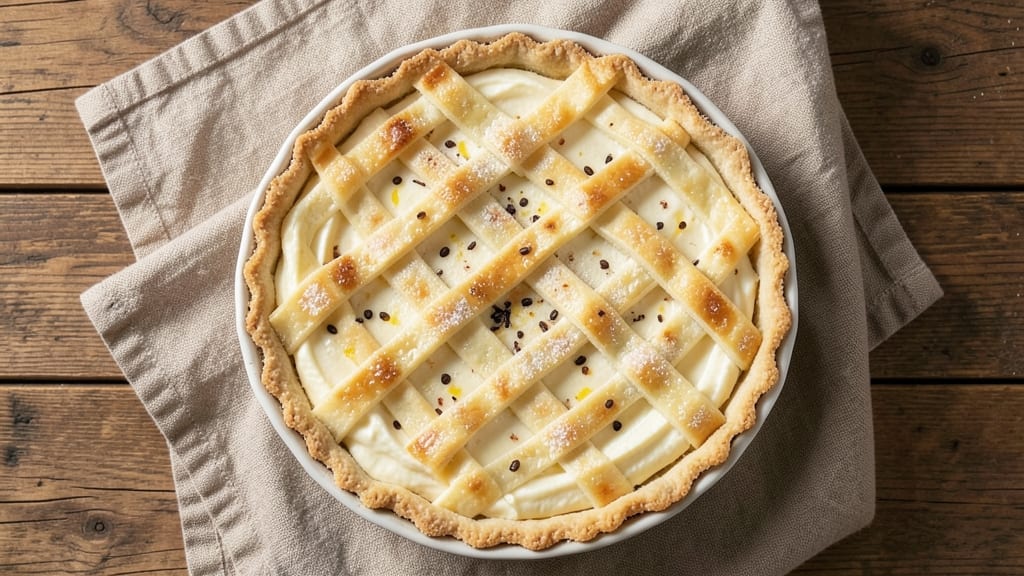
Lidia Bastianich's ricotta pie delivers the essence of Italian baking—creamy vanilla custard cradled in a buttery crust, with a texture that's equal parts tender and rich. This recipe captures her signature approach to custard pies, where precise technique transforms simple ingredients into something extraordinary.
The secret lies in tempering the eggs properly and baking at just the right temperature to achieve that signature silky center.
What makes this ricotta pie truly special is the balance of flavors and textures: a delicate vanilla custard that's neither too sweet nor too tart, complemented by a flaky crust that holds its shape without becoming brittle.
The ricotta adds a subtle tang that brightens the custard, while the cornstarch ensures a smooth, velvety finish. Lidia's method guarantees a pie that's foolproof—no lumps, no cracks, and a perfect golden-brown crust that's crisp enough to stand up to the creamy filling.
The baking process requires patience, with a gradual increase in temperature to prevent cracking while ensuring the custard sets completely. When done right, each slice reveals a warm, custardy center that melts on the tongue, surrounded by that perfect buttery crust.
This is dessert that feels indulgent yet balanced, satisfying enough to be a centerpiece but refined enough for any occasion.
Whether you're serving it warm with a sprinkle of powdered sugar or at room temperature with fresh berries, this ricotta pie is a testament to how Italian baking elevates simple ingredients into something truly memorable.
The technique is straightforward, but the results are anything but ordinary—this is the kind of dessert that makes you feel like you've stepped into a classic Italian trattoria.
Ingredients for ricotta pie recipe lidia
Simple Italian staples transform into Lidia's signature dessert—creamy custard meets flaky crust.
| Ingredient | Amount | Notes |
|---|---|---|
| Ricotta Cheese 🧀 | 1 ½ lbs | Whole-milk, drained overnight |
| Large Eggs 🥚 | 6 whole | Room temperature, separated |
| Granulated Sugar 🍚 | 1 ¼ cups | Superfine preferred for smoothness |
| All-Purpose Flour 🌾 | ½ cup | Sifted, for custard |
| Cornstarch 🌾 | ¼ cup | Essential for velvety texture |
| Vanilla Bean 🌿 | 1 whole | Scraped seeds plus paste |
| Unsalted Butter 🧈 | 1 cup | Cold, cubed for crust |
| All-Purpose Flour 🌾 | 2 ½ cups | Plus 1 tsp salt for crust |
| Ice Water 💧 | ½ cup | For pie dough |
| Salt 🧂 | ½ tsp | Fine sea salt |
| Vanilla Extract 🍋 | 1 tbsp | Pure, for custard |
| Lemon Zest 🍋 | 1 tsp | Brightens custard |
The ricotta makes or breaks this pie. Whole-milk ricotta is non-negotiable—it's richer and less watery than part-skim. Drain it overnight in a fine-mesh strainer lined with cheesecloth to remove excess whey. Trader Joe's and specialty Italian markets carry the best quality. For the crust, European-style butter (like Plugrá) gives superior flavor, but any good unsalted butter works. Keep everything cold when making the dough—this prevents the butter from melting prematurely and ensures flaky layers. The vanilla bean should be high-quality; Madagascar Bourbon is ideal, but Mexican vanilla works too.
No vanilla bean? Double the vanilla extract and add a pinch of cinnamon for depth. Substituting ricotta? Cottage cheese blended smooth works in a pinch, but texture will differ slightly. For the crust, if you're short on butter, lard or shortening can be used, though flavor won't be as rich. The cornstarch is crucial—it's what gives the custard that signature silky texture. If you can't find it, arrowroot powder works at the same ratio. Always sift your dry ingredients to avoid lumps in the custard. The lemon zest can be omitted if you dislike citrus notes, but it's worth the effort for that bright, professional finish.
The custard filling keeps best for 2 days in the fridge, fully assembled. For longer storage, bake the pie, cool completely, then wrap tightly in plastic wrap and store in the fridge for up to 5 days. The crust can be made a day ahead and stored in the fridge—just let it sit at room temperature for 30 minutes before rolling. Freeze unbaked pies for up to 3 months by wrapping tightly in plastic and foil. When reheating, warm slices in a 350°F oven for 10-15 minutes—they taste even better warmed through.
Why You'll Love This Recipe
- Here’s what sold me: that perfect balance of sweetness and tang. The ricotta gives it richness, but the eggs and sugar keep it from tasting heavy. It’s not too sweet, not too dense—just right. Plus, the slight crispness at the edges? Chef’s kiss.
- No-Fuss Mixing: I swear by this recipe because it’s the kind of dessert where you just dump everything in a bowl—ricotta, eggs, sugar—and stir. No whisking until your arm falls off, no sifting flour like it’s a science experiment. The cornstarch does all the heavy lifting for that silky texture, so I can actually enjoy the process instead of stressing over it.
- Creamy Without Cloying: Here’s what sold me: that perfect balance of sweetness and tang. The ricotta gives it richness, but the eggs and sugar keep it from tasting heavy. It’s not too sweet, not too dense—just right. Plus, the slight crispness at the edges? Chef’s kiss.
- Weeknight Magic: Between us, this is my go-to when I need something impressive but can’t be bothered with layers of custard or hours of baking. Serve it warm with a sprinkle of cinnamon, and suddenly you’ve got dessert that feels special—no one will guess it took less than 45 minutes. (Yes, even on a Tuesday night.)
Step-by-step instructions for warm vanilla ricotta pie
Master this Italian classic with a velvety custard filling and crisp buttery crust.
Prepare the Custard Filling
In a large mixing bowl, combine the 1.5 lbs ricotta cheese with the 1.25 cups granulated sugar, 1 tbsp vanilla extract, and 1 tsp lemon zest. Use a hand mixer or whisk to blend until completely smooth and no lumps remain. This step ensures even distribution of flavors throughout the filling.
In a separate bowl, whisk together the 6 whole large eggs, 0.5 cup all-purpose flour, and 0.25 cup cornstarch until fully combined. Slowly pour this mixture into the ricotta mixture while continuing to mix on low speed. The goal is to create a homogeneous batter that will yield a silky texture when baked.
Transfer the custard mixture to a medium saucepan and cook over medium-low heat, stirring constantly with a wooden spoon, until it thickens to a pudding-like consistency (about 8-10 minutes). You'll know it's ready when it coats the back of the spoon and leaves a clean trail when you run your finger through it. Remove from heat immediately to prevent overcooking.
Assemble the Crust
In a food processor, combine the 2.5 cups all-purpose flour and 0.5 tsp salt. Add the 1 cup cold unsalted butter, cut into cubes, and pulse until the mixture resembles coarse crumbs with pea-sized butter pieces remaining. Gradually add the 0.5 cup ice water, pulsing until the dough just comes together.
Turn the dough onto a lightly floured surface and divide it into two equal portions. Roll out one portion to fit a 9-inch pie dish, pressing gently to create an even thickness. The dough should be about ⅛-inch thick throughout. Trim any excess dough hanging over the edge of the pie dish.
Transfer the custard filling to the prepared pie crust, spreading it evenly. The filling should be about ½-inch thick when spread. Fold the excess crust edges inward to create a decorative border, then roll out the second portion of dough to cover the top. Seal the edges by pinching them together firmly with your fingers.
Bake to Golden Perfection
Preheat your oven to 375°F. Place the assembled pie on a baking sheet lined with parchment paper to catch any potential drips. Bake for 45-50 minutes, until the crust is deep golden brown and the filling is set but still slightly jiggly in the center.
I like to check for doneness by gently shaking the pie - if it doesn't wobble much, it's ready. The center should be just set but not completely firm. Remove from the oven and let the pie cool completely on a wire rack before slicing. This resting period allows the filling to fully set and develop its signature creamy texture.
For best results, serve the pie at room temperature. The contrast between the warm, creamy custard and the crisp, buttery crust makes this dessert truly exceptional. Each slice should reveal a perfectly balanced combination of sweet, tangy, and vanilla notes.
Pro Tips For Making Ricotta Pie Recipe Lidia
- Whisk Ricotta First: I learned this the hard way—dumping eggs and sugar into whole ricotta first makes lumps like you wouldn’t believe. Break the ricotta into chunks and whisk it smooth before adding anything else. That way, the eggs and sugar blend in like butter.
- Use Room-Temp Eggs: Cold eggs? No thanks. They’ll make your batter thick and gloopy. Take the eggs out of the fridge 30 minutes before mixing—this recipe relies on a light, airy texture, and cold eggs just won’t cooperate.
- Skip the Overmixing: The moment your batter looks uniform, stop stirring. I used to mix until it was perfectly smooth, but that’s how you end up with a dense, gummy pie instead of a tender, custardy one. Just until combined—no more.
- Bake Until Golden, Not Just Set: Your pie might look done at 325°F, but resist pulling it out until the edges are golden brown—that’s when the cornstarch and flour have fully cooked. I used to cut it short, and the center stayed sticky. Give it 5-10 extra minutes if needed.
Common mistakes when making perfect results
Overmixed Custard
I’ve seen this happen more times than I can count—overmixing the custard turns it gummy instead of silky. The key is gentle blending: once you combine the eggs, flour, and cornstarch, mix just until smooth (about 20 seconds).
Overmixing develops gluten, which ruins the delicate texture. If you’re using a hand mixer, pulse on low speed. 💫
Underbaked Center
An underbaked center is the #1 reason ricotta pies fail. The filling should be just set—not firm, but no jiggle either. Bake until the edges are golden and the center barely wobbles when shaken.
If unsure, check at 40 minutes and tent with foil if browning too fast. Patience here prevents a runny mess.
Dough Too Warm
Cold butter and ice water are non-negotiable for flaky crusts. If your dough feels soft or sticky, it’s too warm. Chill it for 30 minutes before rolling.
I’ve even used the freezer for 10 minutes in hot kitchens. The goal? Butter that stays pea-sized—not melted into the flour. This keeps layers distinct.
Skipping the Strain
Ricotta’s moisture is its enemy. Draining overnight in a cheesecloth-lined strainer removes excess whey, which prevents a watery custard. If you skip this, your pie will taste diluted. Pro tip: Use whole-milk ricotta—it’s richer and drains better than part-skim. No strainer? Press it through a fine-mesh sieve.
Overfilling the Crust
Too much filling = cracked crust. The custard should be ½-inch thick when spread. If your pie dish is larger, reduce filling slightly. I’ve learned this the hard way—overfilled pies split open like a volcano. Weigh the filling if unsure: ~2 lbs max for a 9-inch crust. Balance is everything!
No Egg Tempering
Adding cold custard to hot eggs (or vice versa) causes scrambling. To fix: Whisk eggs slightly first, then slowly drizzle in the warm ricotta mixture while mixing constantly.
The temp difference should be minimal—no more than 20°F. This keeps the custard smooth, not lumpy. Trust me, your pie will thank you.
Nutrition facts
Frequently asked questions
Can I make this ricotta pie ahead of time?
The crust can be prepared 1 day ahead and stored in the fridge—just let it sit at room temperature for 30 minutes before rolling. For the full pie, bake it, cool completely, then wrap tightly in plastic wrap and refrigerate for up to 5 days. The custard flavor actually improves with time! For longer storage, freeze the unbaked pie for up to 3 months.
What if I don't have a vanilla bean?
No problem! Double the vanilla extract to 2 tbsp and add a pinch of cinnamon for depth. For extra richness, stir in 1 tsp orange zest alongside the lemon zest. The flavor will be slightly different but still delicious—this pie is forgiving that way!
How do I fix a cracked crust?
If you see cracks forming during baking, tent the pie with aluminum foil immediately. For minor cracks, they're harmless—just brush with a little extra melted butter after baking for extra shine. The real fix? Don't overfill the crust—keep the custard to ½-inch thick and use ~2 lbs max for a 9-inch pie. Chill the dough longer if your kitchen is warm!
Can I substitute cottage cheese for ricotta?
You can try, but the texture will differ. Blend 1.5 cups cottage cheese until completely smooth to remove lumps, then proceed with the recipe. The result will be slightly less creamy but still tasty. For best results, stick with whole-milk ricotta—it's richer and drains better, giving that signature Italian texture.
Why is my custard grainy?
Graininess usually means the eggs weren't tempered properly or the mixture was cooked too long. First, ensure you're whisking the eggs and dry ingredients together before adding the warm ricotta. Second, remove the custard from heat as soon as it thickens—it will continue setting while cooling. If it's still grainy, strain it through a fine-mesh sieve before filling the pie.